Termites, roaches, ants, or rats in your Lakeland home? One call puts a licensed local exterminator on it.
We are the 24/7 dispatch and matching line for Polk County pest control. Enter your ZIP and the line routes you to an FDACS-licensed operator who actually covers your street — Lakeland, Winter Haven, Bartow, Plant City, Auburndale, Haines City and every corner of Polk County.
Get matched with a licensed Polk County pest pro
Enter your ZIP — the dispatch line connects you with an independent, licensed and insured local operator.
Free to get matched. The licensed operator gives the quote.
24/7 line · A real person answers · Availability of same-day and emergency service depends on the provider.
Spot the problem? Start with the right page.
Each guide tells you what you are looking at, what a licensed Polk County operator will do about it, and what to say on the call so the right pro shows up prepared.
🪲 Termite swarmer wings
Discarded wings on the windowsill, mud tubes on the slab, pinhead frass piles under attic framing. Polk County has subterranean, Formosan and drywood pressure — all three, year-round.
👊 Roaches in the kitchen
Palmetto bugs marching in from the lanai are one problem. Small tan German roaches breeding behind the fridge are a very different one. The treatment paths are not the same.
🐜 Ant trails and mounds
Ghost ants in the bathroom, carpenter ants in damp fascia, fire ant mounds where the kids play, tawny crazy ants swarming AC units in east Polk. Species ID decides the fix.
🐀 Scratching in the attic
Roof rats love Polk County tile roofs and attic insulation. Droppings in the garage, chewed wires, noise at night — exclusion work is the fix, not just traps.
How the Lakeland dispatch line works
Full transparency, because it matters: Lakeland Exterminators is a dispatch and matching service, not a licensed pest control operator. We do not treat homes, price jobs, or send out technicians of our own. Here is exactly what happens when you enter your ZIP.
You enter your ZIP
Describe what you are seeing — wings on the porch, droppings in the pantry, a trail of ants along the baseboard — and a dispatch coordinator reaches out. No forms, no callback queue.
Your ZIP routes the match
Polk County is 2,011 square miles with 17 incorporated cities. Your ZIP routes you to the independent, FDACS-licensed operator covering your specific area — not whoever paid for the top ad slot.
The licensed operator inspects and quotes
An FDACS-licensed technician walks the property, identifies the pest and the conducive conditions, and writes the quote. Pricing comes from the operator, never from us.
Treatment, bond and warranty stay with the pro
Scheduling, treatment plan, retreatment bonds, warranties — all owned by the licensed operator who carries the license and the trade insurance. Our job ends when the right pro picks up.
Verify anyone before you hire them. Every structural pest control operator in Florida is licensed by the Florida Department of Agriculture and Consumer Services under Chapter 482, Florida Statutes. Look any company up — license status, categories, discipline history — at the FDACS license search. We encourage you to check the operator you are matched with. That is your protection, and honest operators welcome it.
Pest problem you can describe? The line is open.
Enter your ZIP and get matched with a licensed Polk County operator now.
Free to get matched. The licensed operator gives the quote.
Why Lakeland pest control is its own thing
Polk County is not Tampa and it is not Orlando. It is the Florida in between — older neighborhoods on sandy ridge soil, new subdivisions punched out of cleared citrus groves, 38 named lakes inside Lakeland city limits alone, and a USDA 9b climate that never gives pests a winter. The operators in our network treat Polk County the way it actually behaves.
Lakefront humidity feeds the crawlers
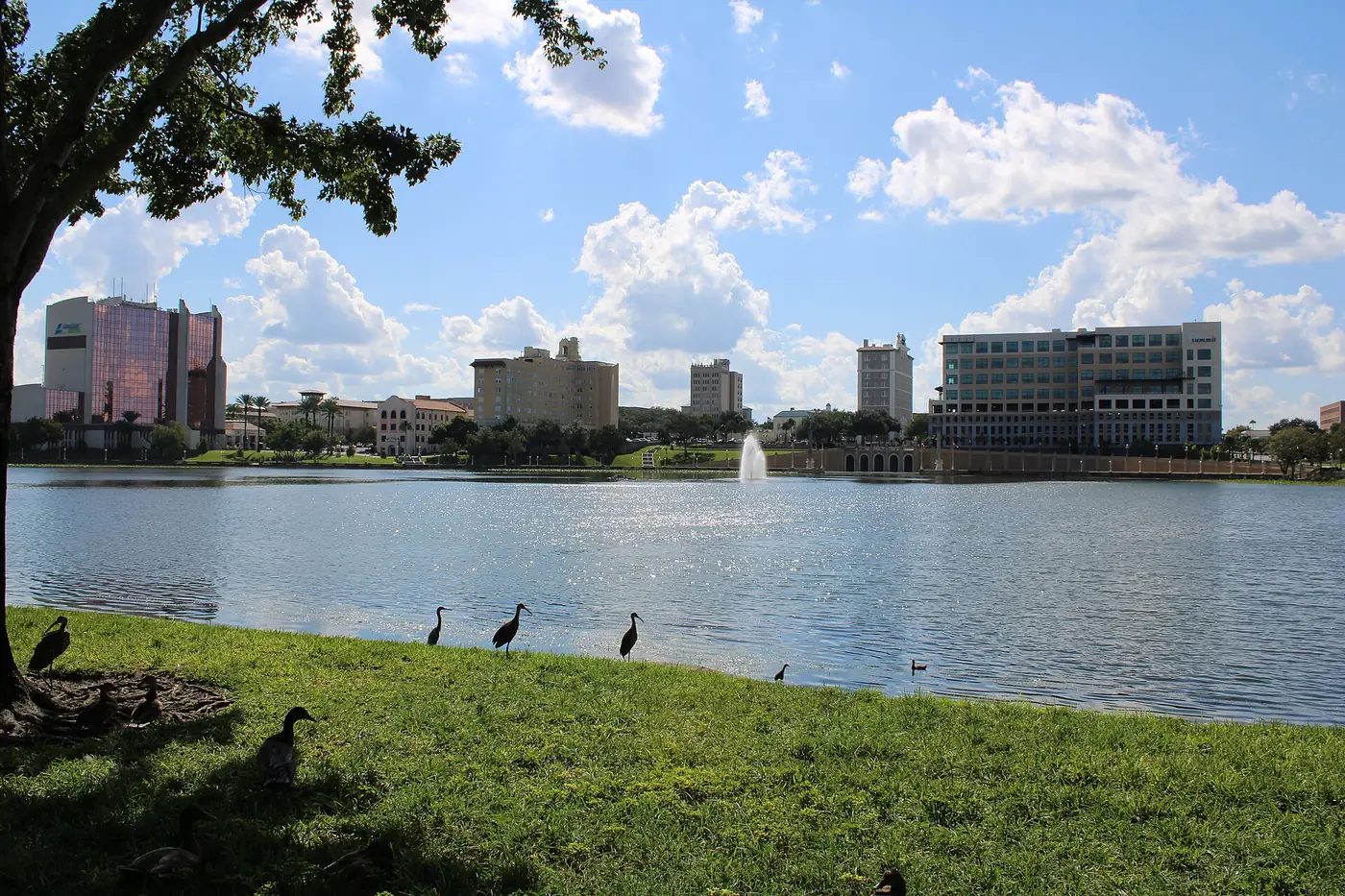
Live within a half mile of Lake Hollingsworth, Lake Mirror, Lake Parker or any of the named lakes — that covers most of Dixieland, Lake Morton, Cleveland Heights and Beacon Hill — and your ambient moisture runs higher than the Polk County baseline. That moisture is exactly what American cockroaches (the palmetto bug), silverfish, earwigs, centipedes and millipedes need. After every heavy summer rain band, the crawl-space and lanai calls spike across the lake districts. If the wet-weather invasion happens at your place every June, the fix is a moisture-and-harborage program, not a one-off spray.
The old-construction termite paradise
Lakeland’s pre-1960 neighborhoods — Dixieland, South Lake Morton, Cleveland Heights, Beacon Hill, the Garden District — are built from what termites consider a buffet: cypress and pine sill plates, pier-and-beam foundations, stucco over original framing, soffits with exposed end grain. Subterranean termites (including established Formosan colonies) come up through slab joints and foundations; drywood swarmers drift in through soffit vents May through August and work invisibly for years. Inspectors in our network find live or past evidence in a large share of the pre-1980 Polk County homes they walk. If your house predates 1980 and has never had a termite evaluation, that is the single highest-value step you can take off this page — start with the termite guide or the WDO inspection guide.
New-construction ant territory
Lakeland Highlands, Christina, the I-4 corridor growth in Auburndale and Davenport — post-2000 builds on freshly disturbed soil trade termite pressure for ant pressure. Tawny crazy ants are established in eastern Polk and moving west, and ghost ants, white-footed ants and Argentine ants all exploit disturbed-soil edges. The right answer is almost never a perimeter spray; it is a baiting program matched to the species, which is why the operator’s ID visit matters. The ant control guide covers what to look for before you get matched.
The citrus-edge effect
Polk County is still one of Florida’s top citrus counties, and a lot of Lakeland, Winter Haven, Bartow and Lake Wales housing sits on former or active grove edge. Grove edge means red imported fire ant pressure spilling into yards and playgrounds, plus the unusual roach mix that comes with packing-house adjacency. Operators familiar with the ag-urban edge treat it differently than a franchise binder says to — and that local difference is most of why this dispatch line exists.
USDA Zone 9b: there is no off-season
Roughly 325 frost-free days, 51 inches of rain, sustained humidity around 75%. Subterranean termites stay active in the soil twelve months a year. German cockroaches breed indoors year-round. Roof rats push into attics when winter food thins outside. Fire ant mounds rebuild within days of rain. Whatever month you are reading this, the pest you are dealing with did not take the season off, and neither do the operators the line routes to.
What the dispatch line routes, by service
Every service routes to an FDACS-licensed Polk County operator who covers your ZIP. Pricing, scheduling, treatment plan and any retreatment bond are between you and the licensed operator.
Termite treatment
Subterranean (liquid barrier and bait systems) and drywood (whole-house fumigation or bounded no-tent work) — routed to WDO-licensed operators.
Rodent control & exclusion
Roof rat and mouse exclusion, trap-out programs, structural seal-outs. Tile-roof attic entry is Polk County’s steadiest rodent call.
Roach & palmetto bug control
American, German and smokybrown cockroach programs — outdoor harborage, indoor breeding sites, and the gel-bait work that actually ends German roach cycles.
Ant control
Fire ants, carpenter ants, ghost ants, tawny crazy ants — species-matched baiting programs, mound treatments and moisture-side carpentry referrals.
General household pest plans
Quarterly and monthly GHP programs covering roaches, ants, spiders, silverfish, earwigs, crickets, centipedes and millipedes.
WDO inspections
NPMA-33 reports for Polk County real estate closings, performed by FDACS WDO-licensed inspectors. FHA and VA lenders scrutinize these — get it done right.
Commercial pest control
Restaurants, hotels, warehouses and multi-family along the I-4 logistics corridor — documented programs that pass health and audit inspections.
Silverfish, spiders & occasional invaders
Silverfish in humid closets, widow spiders in the garage, earwigs after rain — the accepted-species library covers identification and treatment.
Polk County coverage — routed by ZIP
Florida’s fourth-largest county by area. The network covers all 17 incorporated cities plus the unincorporated communities. Routing is by ZIP, not by who answered first.
Winter Haven33880 · 33881 · 33884
Bartow33830 · county seat
Plant City33563 · 33565 · 33566
Lake Wales33853 · 33859 · 33898
Auburndale33823
Haines City33844 · 33845
Mulberry33860
Davenport33837 · 33896 · 33897
Polk City33868
Lakeland Highlands33813
North Lakeland33809 · 33810
South Lakeland33813 · 33803
Highland City33846
Crystal Lakeunincorporated Lakeland
Combee Settlementeast Lakeland
Cypress GardensWinter Haven adjacent
Fort Meade33841
Frostproof33843
Lake Alfred33850
Eagle Lake33839
Dundee33838
InwoodWinter Haven adjacent
Kathleennorthwest Polk
LoughmanChampionsGate corridor
Lake Hamiltonnortheast Polk citrus
How pricing works (and why we don’t publish numbers)
Every quote on every job comes from the independent, FDACS-licensed operator dispatched to your address — never from us. What the operator’s price reflects:
- The pest and the treatment class. A quarterly general-pest plan, a subterranean termite barrier, and a whole-house drywood fumigation are entirely different jobs with entirely different labor and materials.
- The structure. Square footage, slab vs. crawl space, tile vs. shingle roof, attached lanai, detached workshop — all change the scope.
- Severity and access. A first-week German roach issue and a two-year-established one are priced differently, honestly so.
Two things are always true on this line: getting matched costs you nothing, and you owe nothing until you accept the licensed operator’s own quote. Before you accept anyone’s number — ours or a competitor’s referral — ask the operator what the quote includes, whether there is a retreatment bond, and how callbacks are handled. The questions-to-ask guide gives you the full checklist, and the cost guide explains each pricing category in depth.
Lakeland pest control questions, answered straight
Are the pest control operators on the other end of this line actually licensed?
Yes — and you can verify it yourself before you hire anyone. Every Polk County operator the dispatch line routes to is licensed by the Florida Department of Agriculture and Consumer Services (FDACS) under Chapter 482, Florida Statutes, in at least one structural category: GHP (General Household Pest), WDO (Wood-Destroying Organisms), L&O (Lawn & Ornamental) or Fumigation. Punch any company name into the FDACS license search and current status, categories and discipline history come back. Lakeland Exterminators is the dispatch layer — we connect you to the licensed operator; we are not the licensed operator.
How fast can I get matched, and how fast can someone be on site?
A dispatch coordinator follows up quickly after you submit your ZIP. On-site timing belongs to the licensed operator the request routes to — operators set their own schedules, and most in the network run an on-call rotation for genuine emergencies. Same-day and 24/7 emergency service is subject to provider participation, location, technician availability and demand; ask the operator for their real ETA once you’re connected.
Do you cover Winter Haven, Bartow and the rest of Polk County, or just Lakeland?
All of Polk County, routed by ZIP: Lakeland, Winter Haven, Bartow, Plant City (technically Hillsborough, routed the same way), Lake Wales, Auburndale, Haines City, Mulberry, Davenport, Polk City, Eagle Lake, Lake Alfred, Lake Hamilton, Kathleen, Loughman, Frostproof, Fort Meade, Dundee, plus Highland City, Combee Settlement, Crystal Lake, Cypress Gardens, Inwood and the other unincorporated communities. If your ZIP is not listed, submit it anyway — the coordinator can usually route to an operator covering an adjacent area.
What does pest control cost in Polk County?
Pricing is set entirely by the licensed operator dispatched to your address and varies by pest, structure and severity — we do not set or publish prices. What we can tell you: getting matched is free, and the operator’s quote comes after a real inspection, not sight-unseen. The Polk County cost guide explains what drives each category up or down and what to ask before accepting any quote.
Drywood termites — do I really need tenting, or is no-tent treatment legitimate?
Both are legitimate, FDACS-recognized paths; the right one depends on how bounded the infestation is. Whole-house fumigation (sulfuryl fluoride) reaches colonies spread invisibly through framing. No-tent localized treatment is credible when the colony is confined to accessible wood and the operator can verify the extent. Florida is one of only four states where drywood termites are an established structural pest — Polk County sits squarely in the high-pressure zone, so get matched either way.
Do you handle WDO inspections for real estate closings?
Yes — WDO inspections on the NPMA-33 form, performed by FDACS WDO-licensed inspectors in the network, routed by ZIP like everything else. The standard Florida FAR/BAR purchase contract carries a WDO addendum, and FHA and VA lenders treat WDO findings with extra scrutiny. If you are closing on a pre-1980 Polk County home, do not waive this one. Full WDO guide →
Why are roof rats such a Polk County problem?
Housing stock. Polk County is heavy on Spanish-tile and Mediterranean roofs, and roof rats exploit the gap under tile at the eave line, then nest in attic insulation. Pressure spikes in winter when outdoor food thins. Real fixes are structural: tile-gap closures, soffit vent screening, a trap-out period, then quarterly checks. A bait box on the fence line is not a fix. Rodent control guide →
What if I already know the operator I want?
Call them directly — genuinely. The dispatch line exists for homeowners who do not have a pest company relationship and want a quick match to a licensed operator who actually covers their ZIP, instead of spending Saturday morning on six phone calls and three voicemails. Use whichever path is faster for you.
One ZIP. Real Polk County coverage. Get matched now.
Free to get matched. The licensed operator gives the quote.
Free to get matched. The licensed operator gives the quote.
Disclosure
Lakeland Exterminators is a dispatch and matching service. We connect Polk County callers with FDACS-licensed structural pest control operators serving Lakeland, Winter Haven, Bartow, Plant City and the surrounding Polk County area. We are not a licensed pest control operator. We do not perform pest control work, set treatment prices, issue warranties, hold retreatment bonds, or carry pest control trade insurance. All pricing, scheduling, treatment plans, warranties, bonds and service terms are determined by the FDACS-licensed operator dispatched to your address under Chapter 482, Florida Statutes.
Same-day and 24/7 emergency services are subject to provider participation, location, technician availability, and demand. Availability is not guaranteed and may vary by market and appointment capacity.
License status of any operator you connect with is publicly verifiable at the FDACS license search.